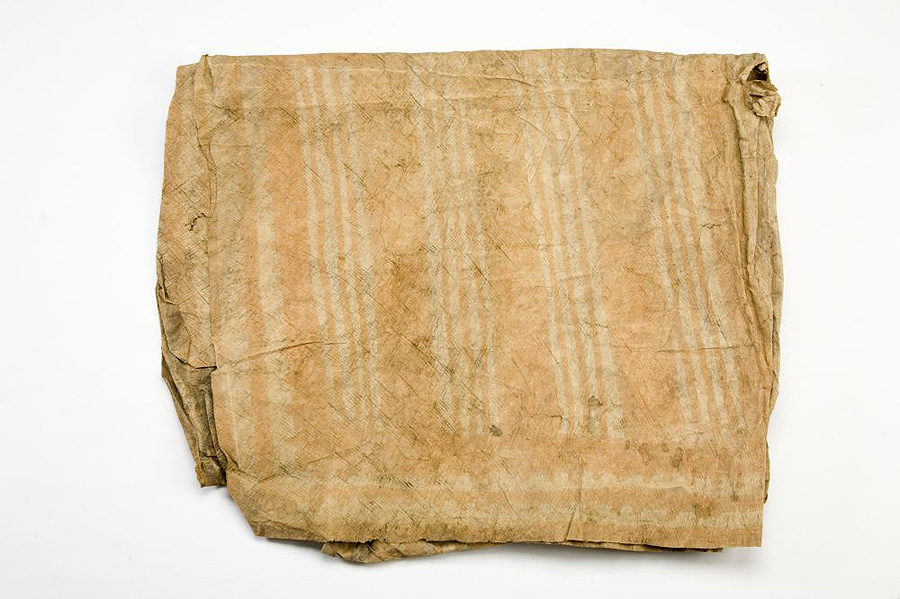
quilt :
probably Fijibefore 1881
barkcloth
121.9 x 213.4 cm
Gift of Henry Allen Otty Cudlip to the Mechanics' Institute, before 1881 (N746)
View Story
In the collection, this textile was a mystery with but one key to its identity. It had no accession number and no associated documentation. Tucked into its folds, however, was an old Mechanics’ Institute label naming the object as a “Striped Quilt” and the donor as “O. Cudlip”. A “striped quilt” appeared on the 1883 Mechanics’ Institute list in the Polynesian section, without further cultural attribution, description or donor’s name. The name O. Cudlip did not appear in any museum records, but some searching revealed that he was Henry Allen Otty Cudlip (1821-1881). Henry was the second son of James Cudlip (1790-1844), a native of Stoke-Fleming, Devonshire, England. James had served in the Royal Navy from 1802 until the end of the War of 1812, after which he moved to New Brunswick. In September 1813 James married Rebecca Waterbury (about 1794-1871), daughter of John Waterbury of Saint John, New Brunswick. James was a member of the Mechanics’ Institute, its president in 1843. His oldest son, John Waterbury Cudlip (Stoke-Fleming 1815-1885 Saint John), was a prominent Saint John merchant, who represented his city in the Legislative Assembly and became Inspector of Customs. Henry was born in Petersville, New Brunswick, in 1821. On 24 May 1849 in Kingsclear, N.B., he married Theodosia Hodgson Scott and for a period of time they must have owned a farm at Nerepis, N.B. In 1860 they sold the farm and moved to New Zealand. Unrest there prompted them after only two months to move on to Fiji. There Henry went into the business of raising cotton, a product that, because of disruptions in supply caused by the American Civil War, found a ready market in England. Eventually, Henry became mayor of the town of Levuka, Fiji, where he died on 17 December 1881. It is likely, therefore, that he sent his donation to the Mechanics’ Institute from Fiji some time between 1860 and 1881.